
Introduction:
Evidence is supportive of the relationship between subjective reporting measures, the moderation of training load and performance (Coyne et al., 2018; Saw et al., 2017; Smith et al., 2016). However, there is a paucity of literature portraying the stresses associated to youth athletes and more so, their sport science (SS) practitioners. The aim of this case study is to provide a retrospective analysis of readiness to perform (RTP) and its relative correlates in each population. It is hoped the findings of this analysis support a more targeted approach to optimising the holistic wellness of youth athletes and their SS practitioners. In doing, this may help support the performance enhancement of each demographic.
Methodology:
98 youth athletes across 6 sports and 8 practitioners across 2 SS disciplines (strength & conditioning, physiotherapy) completed daily wellness logs for a period of 31 weeks. Daily wellness logs were recorded via specialised online software (Metrifit, Health and Sport Technologies Ltd), consisting of subjective ratings (1-5) for mood state, sleep quality, energy, muscle readiness, nutrition quality, stress and health. In addition, sleep duration from the previous day was recorded via self-reported total hours. All subjects received instruction on how to utilise the software. Compliance was supported by optional prompts, reports and online support features.
Results:
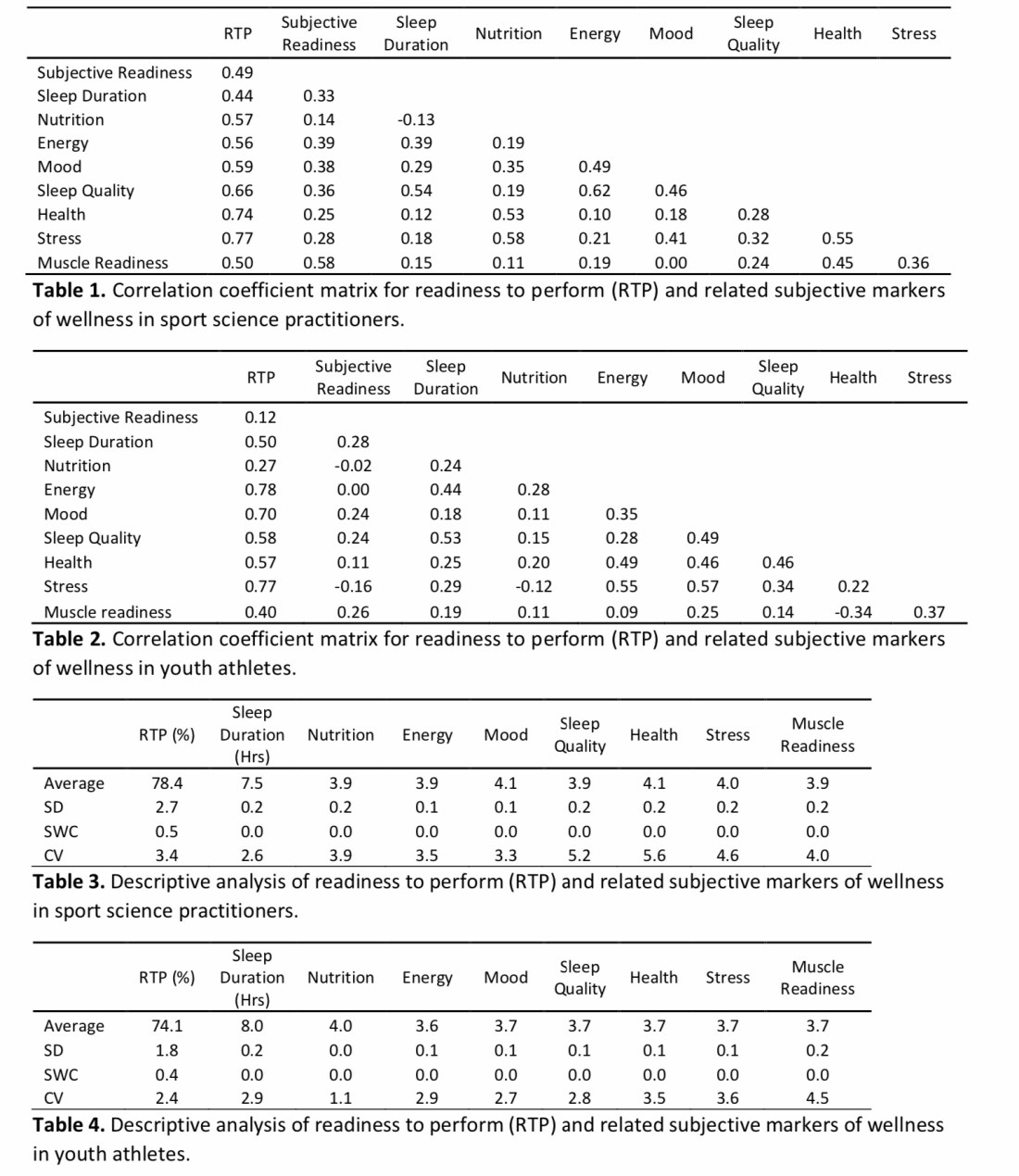
Mean RTP for youth athletes was 74.1% ± 1.8 %. Mean RTP for SS practitioners was 78.4% ± 2.7%. RTP for the youth athletes was most likely lower compared to their SS practitioners (-1.63 ± 0.34). For youth athletes, there was a strong positive correlation between subjective energy (r=0.78), stress (r=0.77) and mood (r=0.70) and RTP. There were moderate to weak positive correlations for all other wellness markers (r=0.58-0.12) and RTP. For SS practitioners, there was a strong positive correlation between subjective stress (r=0.77), health (r=0.74) and RTP. There were moderate positive correlations for all other wellness markers (r=0.66-0.44) and RTP.
Practical Applications:
These results provide a novel insight into the RTP and correlated markers of subjective wellness in youth athletes and their SS practitioners in a leading UK talent development environment. In this context, it may be that the interventions applied to elevate RTP in youth athletes may not be as effective for SS practitioners. As such, demographic specific interventions may be required. For youth athletes, interventions to decrease perceived psychological load, such as positive coping strategies and supportive social networks (Howie et al., 2018; Zambianchi, 2018) may be advantageous. In SS practitioners, interventions to decrease perceived biopsychological load, such as safeguarding against work intensification and promoting sustainable careers (Hymel et al., 2011; Quick and Henderson, 2016) may be advantageous.
Tables:
References:
Coyne, Haff, Coutts, Newton, Nimphius, 2018
The Current State of Subjective Training Load Monitoring – a Practical Perspective and Call to Action https://opus.lib.uts.edu.au/bitstream/10453/129839/1/The%20Current%20State%20of%20Subjecti ve%20Training%20Load%20Monitoring- a%20Practical%20Perspective%20and%20Call%20to%20Action.pdf
Saw, Main, Robertson and Gastin, 2017
Athlete Self-Report Measure Use and Associated Psychological Alterations https://www.mdpi.com/2075-4663/5/3/54/htm
Smith, Coutts, Merlini, Deprez, Lenoir and Marcora, 2016
Mental fatigue impairs soccer-specific physical and technical performance https://www.ncbi.nlm.nih.gov/pubmed/26312616/
Howie, Daniels and Guagliano, 2018
Promoting Physical Activity Through Youth Sport Programs: It’s Social https://www.repository.cam.ac.uk/bitstream/handle/1810/274867/834%20-%20Howie%20et%20al. %202018%20-%20AJLM.pdf?sequence=1&isAllowed=y
Zambianchi, 2018
Time Perspective, Coping Styles, Perceived Efficacy in Affect Regulation, and Creative Problem Solving in Adolescence and Youth
https://journals.copmadrid.org/psed/art/psed2018a1
Hymel, Loeppke, Baase, Burton, 2011
Workplace Health Protection and Promotion: A New Pathway for a Healthier-and Safer-Workforce https://journals.lww.com/joem/Pages/articleviewer.aspx?year=2011&issue=06000&article=00017& type=Fulltext
Quick and Henderson, 2016
Occupational Stress: Preventing Suffering, Enhancing Wellbeing https://www.ncbi.nlm.nih.gov/pmc/articles/PMC4881084/
 Millfield Institute of Sport and Wellbeing