
Introduction:
The physical demands of competitive football have been well described in the literature at a professional senior and academy level (De Silva et al., 2018; Tierney et al., 2016). Despite the large participation numbers, the physical demands of football and its development across chronological age groups have not been explored in school sport. As such, little is known about how to best support the successful transition of youth footballers in school football as they transition through academic year groups. The aim of the study therefore was to analyse the competitive match play demands of football in a leading independent school across U14, U15, U16 and U18 age groups.
Methods:
Twenty-five male football players from a leading independent sports school, participating across U14, U15, U16 and U18, were randomly selected to wear GPS technology (Playertek, Catapult) during the 2018-2019 academic year. Across all four-year groups a total of five competitive matches were analysed. Sprint distance (m), maximum velocity (m/s) and average distance per minute (m/min) were used to identify match play demands. Data was analysed using magnitude-based inferences with the match play demands for each year group analysed against each other.
Results:
For average distance per minute, U14 was most likely greater compared with U16, 2nd X1 and 1st XI (106.63 ± 7.62 m/min VS 70.93 ± 9.88, 69.88 ± 6.67 m/min, 61.56 ± 14.31 m/min respectively) and likely greater than U15 (99.44 ± 6.24 m/min). Sprint distance was likely higher in U14 than U16 (617.89 ± 202.45 m VS 372.31 ± 148.46 m) and unclear VS U15, 2nd XI and 1st XI (606.79 ± 346.27 m, 668.57 ± 149.47 m, 874.16 ± 403.43 m respectively. Max velocity was likely greater in 1st XI than U14 (8.13 ± 0.40 m/s VS 7.56 ± 0.59 m/s).
Practical Application:
These results suggest football and physical preparation coaches in independent schools should be aware of the specific and variable physical activity demands associated to competitive football match play. At a more junior level, the development of the aerobic energy system may be warranted given the extensive match play demands (Baker, 2011). It may be that the more structured and intensive demands of match play in more advanced chronological year groups may require the physical development of high-speed movement and anaerobic energy system development relative to playing position demands (Girard et al., 2011). As such, future analysis in this area may require more detail position specific interventions.
Tables
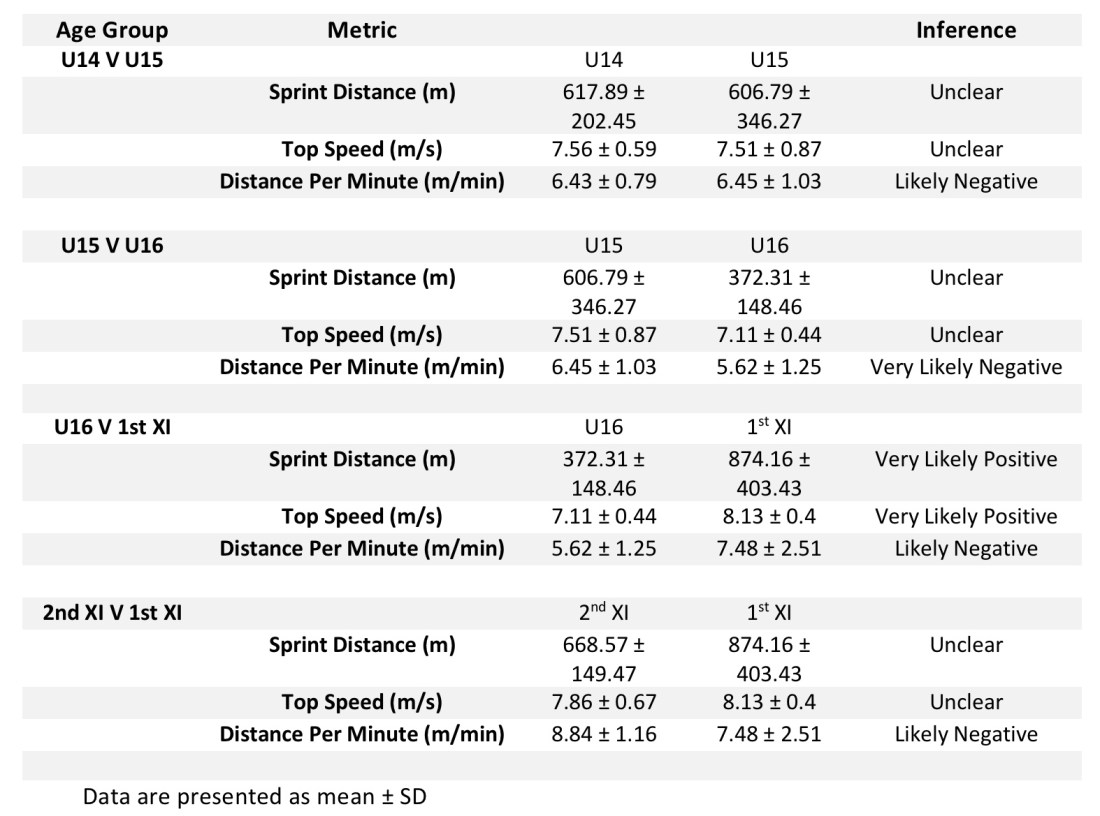
Table 1. Descriptive data and magnitude-based inference for difference in movement demands for school aged male football players between consecutive age groups
References:
De Silva, et al. 2018
Player Tracking Data Analytics as a Tool for Physical Performance Management in Football: A Case Study from Chelsea Football Club Academy
Click to access De%20Silva_sports-06-00130%20%282%29.pdf
Tierney, Young, Clarke and Duncan, 2016
Match play demands of 11 versus 11 professional football using Global Positioning System tracking: Variations across common playing formations
Click to access 11_Vs_11_Position_and_Formation.pdf
Read, et al. 2017
Movement and physical demands of school and university rugby union match-play in England
Baker, 2011
Recent trends in high intensity aerobic training for field sports
Click to access high_intensity_aerobic_training.pdf
Girard, Mendez-Villanueva, Bishop, 2011
Repeated Sprint Ability
https://link.springer.com/article/10.2165/11590550-000000000-00000
 Millfield Institute of Sport and Wellbeing