
Introduction:
Netballer’s transitioning to higher standards of competition are required to develop physical qualities in order to meet the demands of match play (Thomas et al., 2017). There is a similarity in the positional demands of mid-court players against shooters and keepers due to court restrictions (Thomas et al., 2017). However, there is currently limited research on the match demands of mid-court netballers across chronological year groups in school sport. The aim of this study was to investigate the mid-court match demands between U14, U16 and U18 netballers in independent school sport to better optimise their preparation and performance.
Methodology:
Data from 3 matches in the 2018-2019 academic year across the 3 age groups were collected via PlayerTek GPS units (Catapult). Mid court positions were chosen for data collection, including centre, wing attack/defence, goal attack/defence. Magnitude-based inferences were used to analyse the collected data, with the activity profiles for each year group analysed against each other. The activity profiling and subsequent analysis was centred on distance per minute (m/min) and acceleration and deceleration (m/s) count in different zones for each quarter, for each player.
Results:
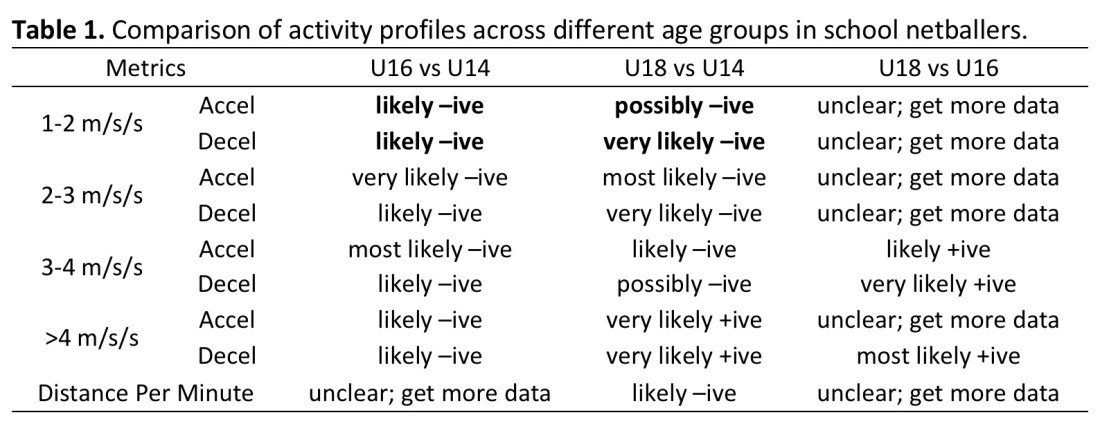
Distance per minute (m.min-1) for each quarter between U16 vs U14 and U18 vs U16 was unclear. There was a likely lower m.min-1 for U18 compared to U14. For U16 compared to U14, acceleration count at 1-2 m.s-2min-1, >4 m.s-2min-1 and deceleration count at all zones (1->4 m.s-2min-1) were likely lower. For U18 compared to U14, acceleration and deceleration count at speed zones 1-4 m.s-2min-1 were possibly lower to very likely lower and were very likely higher at >4 m.s-2min-1. For U18 compared to U16, acceleration and deceleration count at 1-2 m.s-2min-1, 2-3 m.s-2min-1 and acceleration count at >4 m.s-2min-1 were unclear, and acceleration and deceleration count at 3-4 m.s-2min-1 and deceleration at >4 m.s-2min-1 were most likely higher to very likely higher.
Practical Applications:
These findings provide a novel insight into the match demands of netball between different age groups in independent school sport. Netball support staff should be aware of the unique match play demands within this demographic. At more advanced age groups, the development of maximum concentric and eccentric force production, alongside an enhanced acceleration and deceleration profile may be advantageous. In addition, the conditioning of the anaerobic energy system may supplement the repeated expression of these capacities (Bishop et al., 2011). At the more junior age groups, the early introduction of a curriculum to develop effective movement skills and capacities for the expression of force may be warranted.
Table:
References:
Bishop, D., Girard, O., & Mendez-Villanueva, A. (2011). Repeated-sprint ability—Part II. Sports medicine, 41(9), 741-756.
https://link.springer.com/article/10.2165/11590560-000000000-00000
Thomas, C., Ismail, K. T., Simpson, R., Comfort, P., Jones, P. A., & Dos’Santos, T. (2017).
Physical profiles of female academy netball players by position. Journal of Strength and Conditioning research, 1
Thomas, C., Comfort, P., Jones, P. A., & Dos’ Santos, T. (2017).
Strength and conditioning for netball: A needs analysis and training recommendations. Strength & Conditioning Journal, 39(4), 10-21.
 Millfield Institute of Sport and Wellbeing