
Introduction:
Due to the high incidence of change of direction (COD) in tennis, the ability to express the physical capacities that underpin COD performance through combination of acceleration, deceleration and turning mechanics is critical within competitive match play. Additionally, the literature suggest biological changes within youth can impact the expression of physical capacities. As such, the department aimed to compare academic year groups performance of 5m acceleration and 505 COD deficit (CODD) within tennis athletes.
Methods:
Data was analysed retrospectively from a testing battery undertaken termly over three academic years from 2017-2019. 142 data sets were collected across 5 academic year groups. Linear Acceleration performance was assessed via 5m time, measured via Brower timing gates. Scores were expressed as an average of 3 attempts within each participant. CODD was assessed through a 505 assessment where CODD represented the difference between average 505 and 10m time, where the mean 10m time was taken from the linear speed assessment (Nimbus et al., 2016). Data was analysed via magnitude-based inferences, where consecutive year group performances were compared.
Results:
In 5m performance (Figure 1), year 13 was most likely lower than years 9, 10, 11 and 12 (-1.75 ± 0.26, -2.51 ± 0.40, -2.88 ± 0.44 and -3.80 ± 0.13 respectively). Year 10 showed very likely lower 5m times than year 9 (-0.68 ± 0.31). Years 11 and 12 displayed a very likely increase and unclear difference when compared to year 10 (0.73 ± 0.28 and 0.07 ± 0.44 respectively). In CODD performance (Figure 2), Years 10, 11 and 12 were all very likely lower than year 9 (-1.45 ± 0.91, -0.49 ± 0.28 and -0.50 ± 0.25 respectively). Year 13 were most likely lower than years 11 and 12 (-0.66 ± 0.05 and -0.67 ± 0.19 respectively). Year 11 and 12 CODD time showed a possible increase compared to year 10 (0.21 ± 0.26 and 0.20 ±0.29 respectively).
Practical Applications:
These results highlight the importance of early integration of acceleration and COD skill development within youth tennis. The authors highlight a possible ‘hazard phase’ between years 10-12, where 5m and COD performance appears to be compromised. It is speculated this phase may coincide with normative onset of peak weight velocity, which may inhibit expression of physical capacities associated with 5m and 505 COD performance. This may highlight the need for analysis of maturational data collection within this time frame to further investigate the effects of maturation on acceleration and COD performance in youth tennis players.
Tables and Figures:
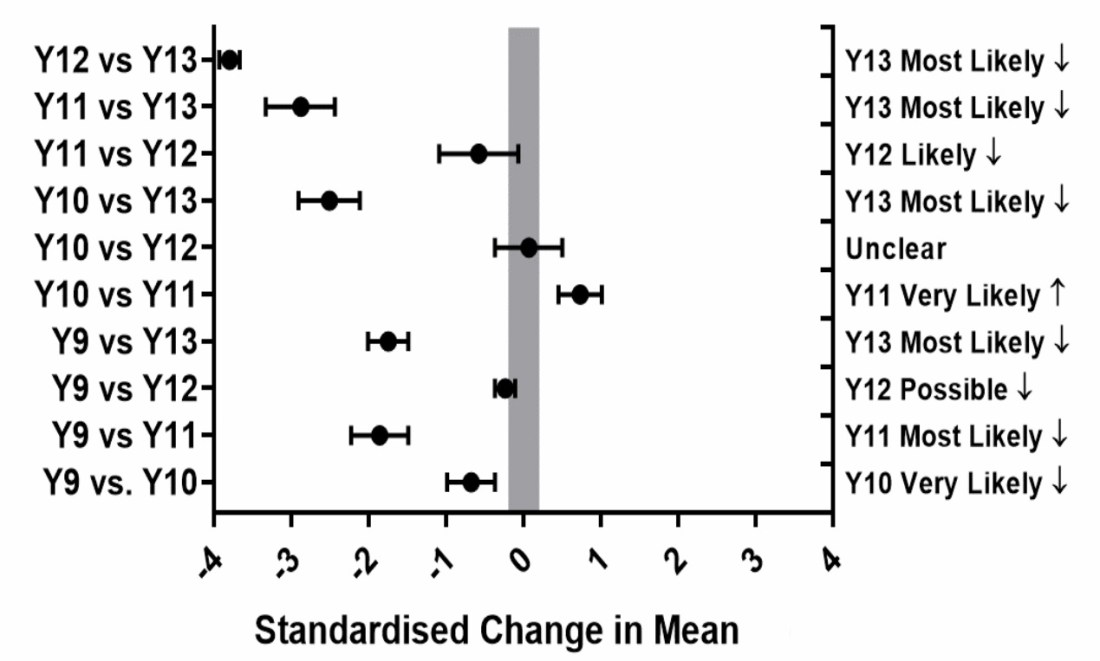 Figure 1. Consecutive year group differences in 5m sprint performance. Data represented as standardised change in mean (± 90% CI) with MBI’s.
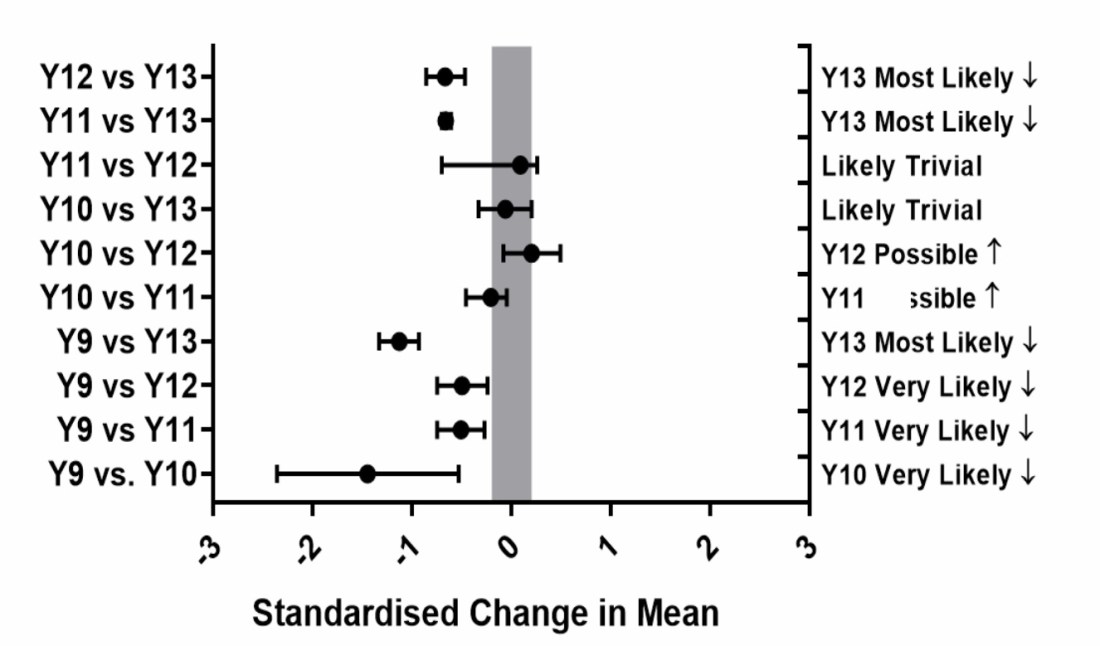
Figure 2. Consecutive year group differences in 505 CODD. Data represented as standardised change in mean (± 90% CI) with MBI’s.
References:
Nimbus, Callaghan, Spiteri, Lockie, 2016
Change of Direction Deficit: A More Isolated Measure of Change of Direction Performance Than Total 505 Time
Cooke, Quin, Sibte, 2011
Testing Speed and Agility in Elite Tennis Players
Kovacs, Roetert, Ellenbecker, 2008
Efficient Deceleration: The Forgotten Factor in Tennis-Specific Training
 Millfield Institute of Sport and Wellbeing