
Introduction:
Concussion incidence within youth rugby union can be as high as 14.7 concussions per 1000/hrs of exposure (Kirkwood, et al. 2015). Studies have evaluated targeted strength training protocols in adult sport to reduce concussion risk. There has been a lack of replication within youth sport. Studies that have investigated the relationships between neck strength and concussion risk have indicated that weaker neck musculature may increase the risk of sustaining a concussion within an adolescent population (Collins, et al. 2014). As such, an understanding of the potential risk factors for concussion that may present themselves in this population may support more targeted interventions. The purpose of this study was to investigate the relationship between head and neck circumference, isometric neck strength and concussion occurrence in independent school rugby players and propose strategies to reduce injury risk based on these relationships.
Methods:
58 males from years 9-13 completed head and neck circumference and isometric neck strength assessments during the 2018-19 academic year. Measurement protocols consistent with reported protocols in the literature (Versteegh, et al., 2015), assessed isometric cervical flexion, extension, left/right lateral flexion, left/right rotation and combined left/right rotation with lateral flexion strength, head and neck circumference. Isometric neck strength data were collected using a Mirco-fet 2 Dynometer. Subjects completed a familiarisation session on the assessment protocol. Subjects were assigned to concussion or non-concussion groups based on the occurrence of concussion in the 12-month period preceding data collection.
Results:
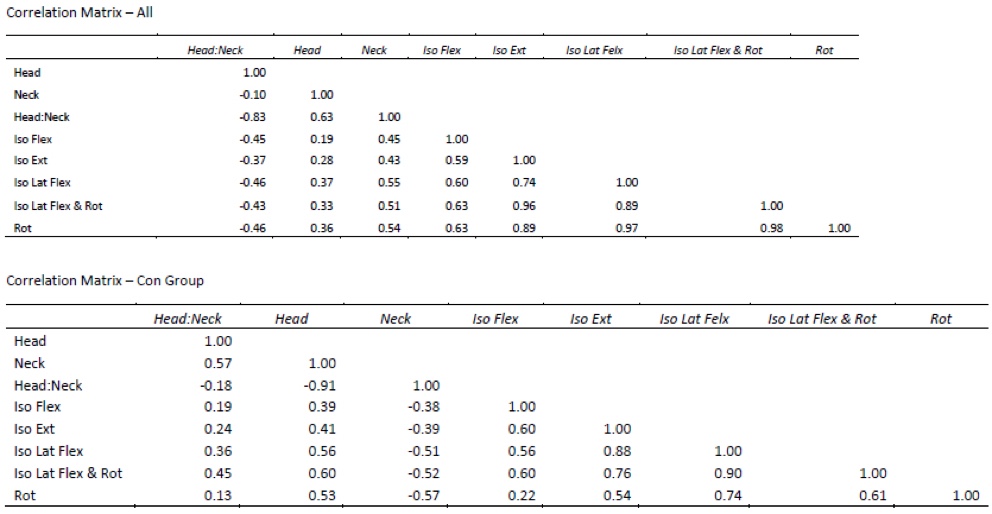
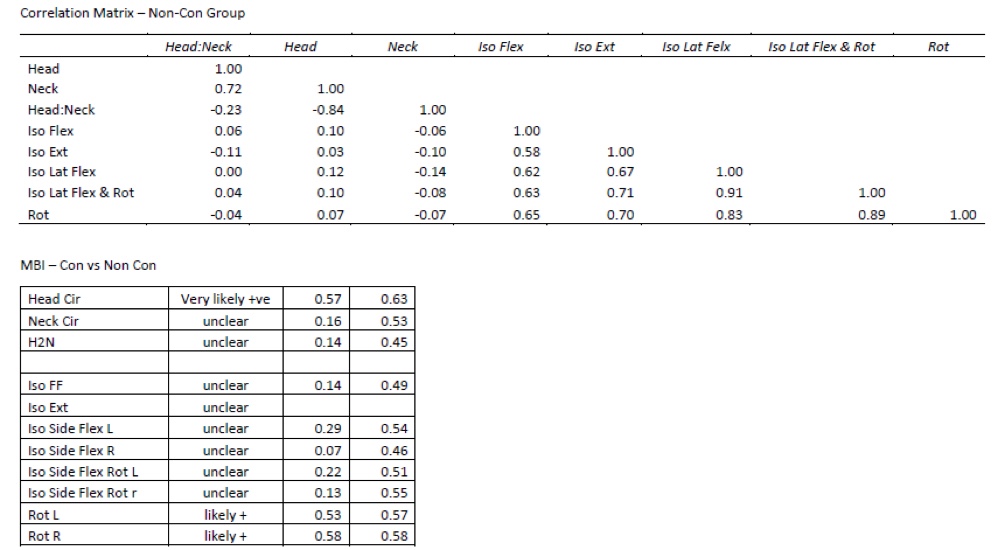
Head circumference was very likely greater in the non-concussion vs concussion groups. Isometric left and right rotation strength were likely greater in the non-concussion vs concussion groups. Isometric strength, circumference and circumference ratios were unclear between the concussion and non-concussion groups for all other tests. There were strong positive correlations between isometric extension (r=0.70), lateral flexion (r=0.83), lateral flexion and rotation (r=0.89) and isometric rotation strength in the non-concussion group. There was a moderate positive relationship between head circumference and isometric lateral flexion (r=0.56), lateral flexion and rotation (r=0.60), and rotation (r=0.53) in the concussion group. See appendix 1 for all normative, correlation and MBI data sets.
Practical application:
These findings provide a novel insight into the head and neck circumference and isometric neck strength of concussed vs non-concussed rugby players in a leading independent sports school. As such, neck-training interventions targeting the development of isometric rotation strength may have the potential to reduce concussion occurrence. The development of isometric rotation strength may be supported by the development of isometric strength through a variety of planes of motion. Fisher, et al (2016) demonstrated a targeted neck strengthening programme in adolescents can be effective in the development of strength in adolescent population, this coupled with evidence that increased neck strength may create greater resilience to impulsive loads (Eckner, et al. 2014), provides the basis for specific targeting of neck strength within the adolescent population. Given the fact that an enhanced girth profile of the neck may not warrant specific development, a lowered risk of concussion in youth rugby players may be achieved via neurally driven adaptations to neck strength training.
Appendix 1. Normative, correlation and MBI data sets

References:
Collins, C.L., Fletcher, E.N., Fields, S.K., Kluchurosky, L., Rohrkemper, M.K., Comstock, R.D. and Cantu, R.C., 2014. Neck strength: a protective factor reducing risk for concussion in high school sports. The journal of primary prevention, 35(5), pp.309-319.
Eckner, J.T., Oh, Y.K., Joshi, M.S., Richardson, J.K. and Ashton-Miller, J.A., 2014. Effect of neck muscle strength and anticipatory cervical muscle activation on the kinematic response of the head to impulsive loads. The American journal of sports medicine, 42(3), pp.566-576.
Fisher, James P., Mark Asanovich, Ralph Cornwell, and James Steele. “A neck strengthening protocol in adolescent males and females for athletic injury prevention.” Journal of trainology 5, no. 1 (2016): 13-17.
Kirkwood, G., Parekh, N., Ofori-Asenso, R. and Pollock, A.M., 2015. Concussion in youth rugby union and rugby league: a systematic review. Br J Sports Med, 49(8), pp.506-510.
Versteegh, T., Beaudet, D., Greenbaum, M., Hellyer, L., Tritton, A. and Walton, D., 2015. Evaluating the reliability of a novel neck-strength assessment protocol for healthy adults using self-generated resistance with a hand-held dynamometer. Physiotherapy Canada, 67(1), pp.58-64
 Millfield Institute of Sport and Wellbeing